Two Revolutionary Technologies. One Autonomous Platform.

Modern industry demands more than incremental efficiency, it requires radical transformation. Hydro Puls Systems has developed two complementary technological pillars engineered to eliminate mechanical friction, prevent reactor fouling, and maximize unit economics across global energy, manufacturing, and environmental sectors.

The Future of Energy & Material Processing

Powerful. Clean. Autonomous.

Hydro Puls Systems redefines heavy industry with a software-defined hardware core. By replacing friction-heavy, high-maintenance machinery with advanced fluid kinetics and zero-wear architecture, we turn energy conversion and material processing into bankable, highly profitable assets.


One standardized hardware core. 139 documented industrial applications.

Most clean-tech companies build a single-purpose machine for a single market, and get stuck in custom engineering bottlenecks when trying to scale.

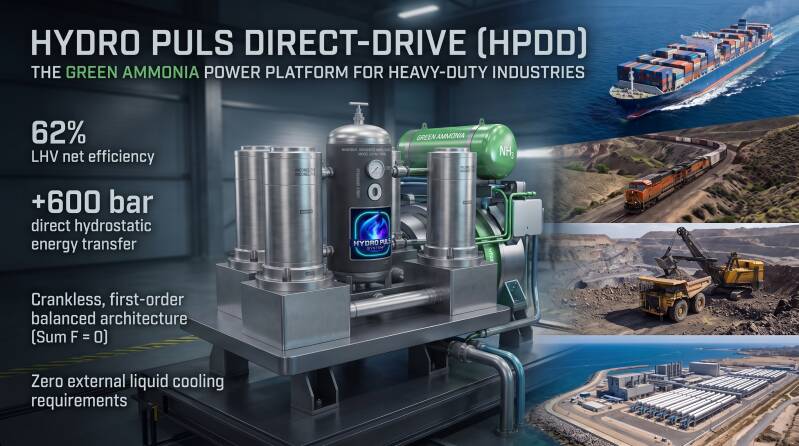
At Hydro Puls Direct-Drive (HPDD), we took the opposite approach: horizontal scalability from one hermetically sealed, frictionless thermodynamic core (+600 bar hydraulic pulse, 230 °C closed-loop siloxane thermal management, and 25-micron gas-curtain sealing).

Instead of redesigning the engine for every industry, the same standardized modular core powers 139 documented applications across 8 major global sectors:


⚡ Energy & Utilities (AI Data Centers, 10 MW–100 MW hubs, BESS replacement, fusion/nuclear cooling)

💧 Environment/Agro & Water (Zero Liquid Discharge, desalination, AWG, DAC carbon capture, plastic pyrolysis)

🧪 Chemical Solutions (Green ammonia, e-methanol, 600-bar hydrogen, methane-to-graphene)

⛏️ Materials & Mining (1-micron cement, urban mining, waterless fracking, biochar & metallurgical monoliths)

🚢 Transport & Heavy Industry (Maritime propulsion, LNG/BOG reliquefaction, food & pharma precision)

🌾 Buildings (Agro-thermal jets, residential & commercial utility modules, defense)


One core architecture. Mass-manufactured in standardized containerized skids. Deployable anywhere, and available via Energy-as-a-Service (EaaS) with zero upfront CAPEX.


1. Hydro Puls Direct-Drive (HPDD)

The Autonomous Process & Energy Core

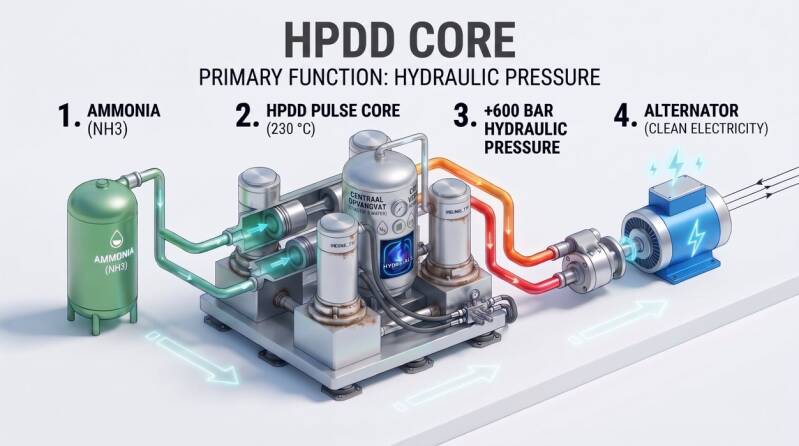
The Hydro Puls Direct-Drive (HPDD) platform replaces legacy crankshafts, high-wear seals, and parasitic mechanical couplings with a frictionless, opposed-piston linear direct-drive matrix.

Operating under a strict 230 °C wall isotherm with precise 109 µm Inconel thermal expansion and a 25-micron gas interface, the HPDD core eliminates metal-to-metal wear and gas blow-by while delivering +600 bar continuous hydrostatic work at 63% net efficiency.

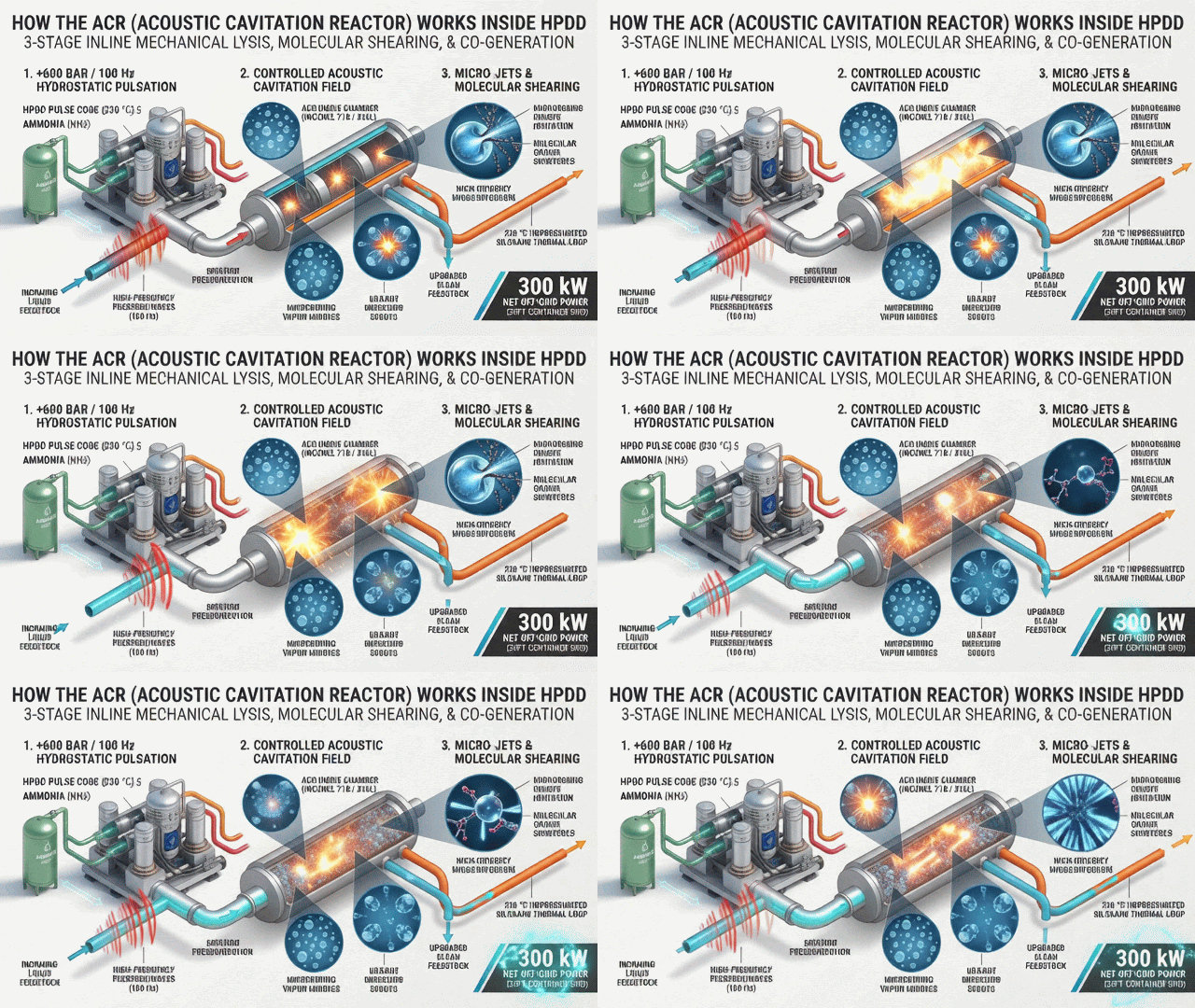
Coupled with the Acoustic Cavitation Reactor (ACR), it unlocks 100% chemical-free, zero-emission processing for heavy industrial waste, biofuel valorization, and decarbonized thermal utilities.

Primary Applications: Chemical-Free Residue Valorization, Industrial Decarbonization, Zero-Emission Fluid Power.


2. The HPDD Acoustic Cavitation Reactor (ACR)

In-Flight Process Intensification & Material Upgrading

The Acoustic Cavitation Reactor solves the historic bottleneck of industrial processing: reactor fouling, coking, and mechanical degradation. By executing multi-phase reactions completely in-flight (mid-air in suspension), feedstocks never touch or foul internal reactor walls.

Utilizing a supersonic nitrogen carrier loop at 600 bar and 850°C, custom De Laval nozzle arrays generate high-frequency acoustic decompression shockwaves (past Mach 2.5). Raw materials and complex waste streams are flash-shattered within milliseconds into uniform, dry sub-micron powders.

  • Primary Applications: Biochar & Pyrolysis Upgrading, Zero-Liquid Discharge (ZLD) Water, Cement 2.0 Calcination.


Grounded in First-Principles Science & Institutional Rigor

Our technology isn't built in isolation. Guided by the scientific leadership of Prof. Dr. Mohamed Amin and developed in collaboration with global academic institutions, research centers, and EPCM partners, the HPDD platform is engineered to satisfy the most rigid underwriting standards of Tier-1 energy and infrastructure investors.

  • Globally Patented: Protected multi-physics architecture and mechanical designs.
  • Validated Unit Economics: Proven low OPEX (~0.72 kWh/m³) and zero-degradation hardware nodes.
  • Field-Ready Deployment: Built to transition seamlessly from validated modeling to continuous real-world operation.

Ready to Upgrade Your Industrial Infrastructure?

Whether you are looking to retrofit existing assets, eliminate environmental liabilities, or deploy autonomous energy nodes, Hydro Puls Systems provides the complete technical and economic framework.


NEWS

Steelmaking

An integrated steel plant withdraws roughly 20 to 60 m³ of water per ton of steel produced, losing 1 to 3 m³ permanently through evaporative cooling towers. Add high ambient temperatures (40–50 °C in key steel hubs), oil- and mill-scale-contaminated rolling water, and heavy hydraulic loads, and conventional utilities quickly become a production bottleneck.

Read more »

ACR

Conventional industrial processing still relies heavily on harsh chemicals, solvents, and energy-intensive thermal cracking to break down emulsions, lyse biomass, or upgrade feedstocks. Inside Hydro Puls Direct-Drive (HPDD), we replace chemical intensity with pure, controlled fluid physics.

Read more »

Freshwater from the sea

That is the visionary premise behind the Water Camel Project (developed by William B. Hawley under the Water Sustainability and Solutions Program): using autonomous variable-buoyancy subsea collectors to capture natural What if co discharges at deep-seabed springs before they mix with seawater, transporting up to 3.7 million gallons per cycle via sea-recovery vessels to coastal hubs.

Read more »

COP 31

Not because the 1.5 °C target is physically impossible, but because the negotiating table is dominated by policy rhetoric rather than fundamental engineering and thermodynamic expertise. 🌍⚠️

Read more »

Zinc Electrowinning Cell House

In heavy hydrometallurgy and electrowinning, spent electrolyte (~38 °C) must stay tightly controlled to protect current efficiency, cathode purity, and equipment life. During hot summers and humid monsoon seasons, conventional evaporative cooling towers lose wet-bulb capacity and electric chillers add massive parasitic loads.

Read more »